
Why Hire a Boutique Firm Like David Kameron Construction for Your Commercial Project?
Heavy steel goes up. A crane sets a structural girder into place on one of our active commercial builds, part of the framing phase where a project starts to take real shape.
When you're planning a commercial build, it's tempting to assume bigger is safer. A large firm has more people, more equipment, more name recognition. But bigger isn't always better, and for a lot of commercial projects in Albuquerque and Santa Fe, a boutique firm is actually the smarter choice. Here's when and why.
You Get Direct Access to the Person Running Your Job
At a large firm, your point of contact is usually a project manager managing several jobs at once. At a boutique firm, you're often working directly with the person whose name is on the door. That means faster answers, fewer miscommunications, and someone who's personally accountable for how your project turns out, not just contractually, but reputationally.
Your Project Gets Custom Attention, Not a Template
Large firms are built for repeatable processes, which makes sense at their scale. But complex or unusual designs, an adaptive reuse project, a build with unconventional materials, a space with a distinct architectural identity, often need more hands-on problem solving than a standardized process is built for. A smaller firm has the flexibility to actually design around your building's quirks instead of fitting your project into a system built for something else.
You're Building Something That Lasts, Not Just Something That Works
A large firm's job is to deliver a building that meets code, hits the budget, and opens on schedule. That's the whole scope, and there's nothing wrong with it. But a boutique firm has room to care about something beyond function: how the building looks, how it feels to walk through, whether it adds something to the block it sits on.
Commercial buildings outlive the businesses inside them. A well-designed space becomes part of a city's character, the kind of building people point to, remember, and eventually think of as a landmark. That doesn't happen by accident, and it rarely happens inside a standardized process built for speed and repeatability. It happens when the people building it are treating the work as craft, not just construction, and have the flexibility to make that a priority.
If part of what you want from your commercial project is a building that's genuinely beautiful, distinct, and built to be a lasting piece of Albuquerque or Santa Fe rather than another forgettable box, that's exactly the kind of project a boutique firm is built for.
Decisions Move Faster
Every layer of management between you and the people doing the work is a layer of delay. Large firms often route change orders, material decisions, and scheduling adjustments through multiple approval steps. A boutique firm has fewer layers, which usually means faster decisions and a shorter path from "we need to change this" to it actually getting changed on site.
Lower Overhead Can Mean More Competitive Pricing
Large firms carry the cost of bigger corporate infrastructure, more administrative staff, more overhead, and that gets built into their bids. A boutique firm typically runs leaner, which can translate directly into more competitive pricing for the same scope of work, without cutting corners on quality.
Local Knowledge That Actually Matters
A firm based in New Mexico and working here regularly knows Albuquerque and Santa Fe's permitting offices, inspectors, and code requirements firsthand, not from a regional playbook. That local knowledge shows up in fewer surprises during permitting and inspections, and in subcontractor relationships built over years of working the same market.
A Boutique Firm Has More Riding on Your Satisfaction
Large firms move on to the next project regardless of how any one client feels. A boutique firm depends on referrals and reputation in a smaller market to stay in business. That changes the incentive: your satisfaction isn't just good practice, it's essential to how the next job comes in the door.
Is a Boutique Firm Right for Your Project?
Not every commercial project needs a boutique firm. If you need to build ten identical retail locations across three states, a large firm's scale and systems make sense. But if you're building something specific to your business, working within a tight timeline, want to actually know who's overseeing your project day to day, or want the finished building to be something more than just square footage, a boutique firm is often the better fit.
If you're planning a commercial project in Albuquerque or Santa Fe and want to talk through what makes sense for your build, contact us. We'd be glad to take a look.
David Kameron Construction is a licensed general contractor (NM GB98 #397368) serving Albuquerque and Santa Fe.
How much does a residential kitchen remodel cost in Santa Fe?
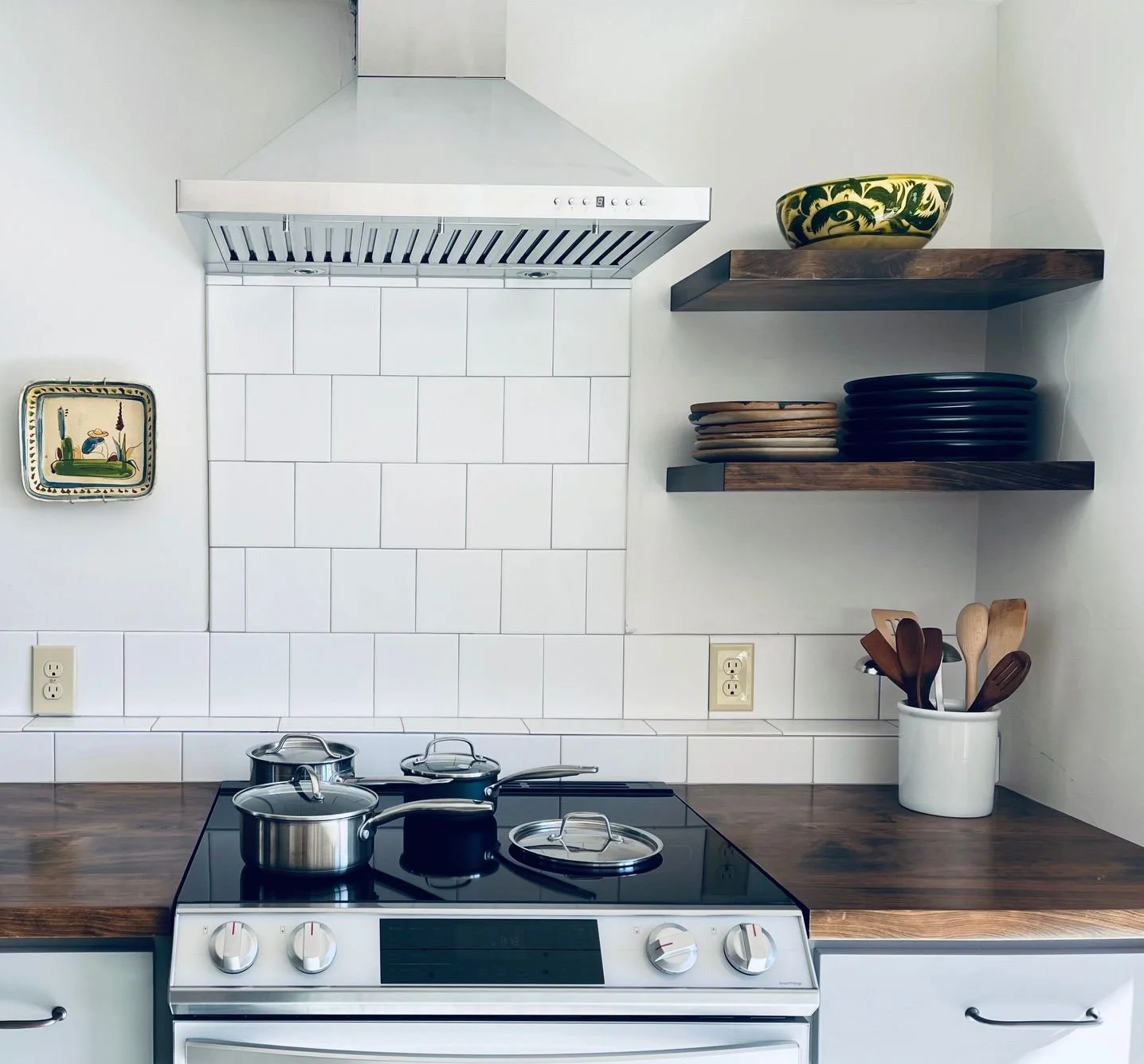
A bright, updated kitchen featuring a classic white tile backsplash and new range, part of a recent Santa Fe residential remodel.
If you've called around Santa Fe getting quotes on a kitchen remodel, you've probably noticed something: the numbers are all over the place. One contractor tells you $30,000, another tells you $90,000, and you're left wondering if they even looked at the same kitchen.
Here's the honest answer: it depends on how much of the kitchen you're actually changing, and Santa Fe has a few local factors that push costs around more than you'd see in most other markets. Let's break it down.
The Quick Answer
For a standard residential kitchen remodel in Santa Fe, you're generally looking at:
Cosmetic refresh: $100 to $150 per square foot
Mid-range remodel (new cabinets, counters, appliances, layout stays the same): $150 to $250 per square foot
High-end / custom remodel (layout changes, structural work, premium finishes): $250 to $450+ per square foot
For an average 150 to 200 sq ft kitchen, that puts most projects somewhere between $20,000 and $50,000, with high-end custom work climbing well past that.
Why the Range Is So Wide
A kitchen remodel isn't one project, it's five or six smaller ones stacked together: cabinetry, countertops, flooring, appliances, plumbing, and electrical, plus labor to tie it all together. Change any one of those and the number moves.
Cabinetry is usually the single biggest line item, often 25 to 35% of your total budget. Stock cabinets versus semi-custom versus fully custom can swing your total by tens of thousands of dollars on their own.
Labor in Santa Fe runs higher than a lot of markets. The pool of licensed, experienced contractors and specialty trades here is smaller relative to demand, and it shows up in the bid. If your project needs adobe or plaster specialists, or Saltillo tile setters, those trades command rates that reflect skills you won't find everywhere.
Scope matters more than square footage. A 150 sq ft kitchen where you're moving plumbing and knocking out a wall can easily cost more than a 250 sq ft kitchen where you're just swapping cabinets and countertops in place.
What Makes Santa Fe Different
A few things specific to this market that don't show up in national cost guides:
Historic district and design review. If your home falls within Santa Fe's historic overlay districts, exterior and sometimes structural changes go through design review, which adds both time and cost to a project, typically a few weeks to a couple months, depending on scope.
Adobe and traditional materials. If you're maintaining or matching adobe construction, that adds a real premium, often 15 to 25% over standard framing, because it requires specialized skill and isn't something every contractor in the state does regularly. Stucco is more common, more widely available, and holds up well against our dry climate, but it's a different look and a different conversation depending on your home's style.
Permitting. Permit costs and timelines here run a bit longer than in Albuquerque, especially for anything touching the building envelope or historic districts. Worth factoring into your timeline expectations up front, not halfway through the project.
A Rough Example
Say you've got a 180 sq ft kitchen and you're doing a mid-range remodel: new cabinets, quartz counters, updated appliances, same footprint.
CategoryEstimated CostCabinetry$10,000 to $16,000Countertops$3,500 to $6,500Appliances$4,000 to $8,000Flooring$2,000 to $4,000Plumbing & electrical$3,000 to $6,000Labor & installation$6,000 to $10,000Total$28,500 to $50,500
Move a wall, relocate plumbing, or go custom on the cabinetry, and this number moves up fast. Keep the layout and go with stock or semi-custom finishes, and you can land toward the lower end.
How to Get a Number You Can Actually Trust
The only way to get a real number for your kitchen is a walkthrough: square footage, existing layout, what's staying and what's going, and what finish level you're after. Anyone quoting you a firm number before seeing the space is guessing.
If you're planning a kitchen remodel in Santa Fe or Albuquerque, I'm happy to come take a look and talk through what actually makes sense for your home and your budget. Contact us to set up a walkthrough.
David Kameron Construction is a licensed general contractor (NM GB98 #397368) serving Albuquerque and Santa Fe.

Just out here building things
I’m not a writer, but my Web designer said it would help people find my site if there were some words on it instead of just pictures of what I have built. :)